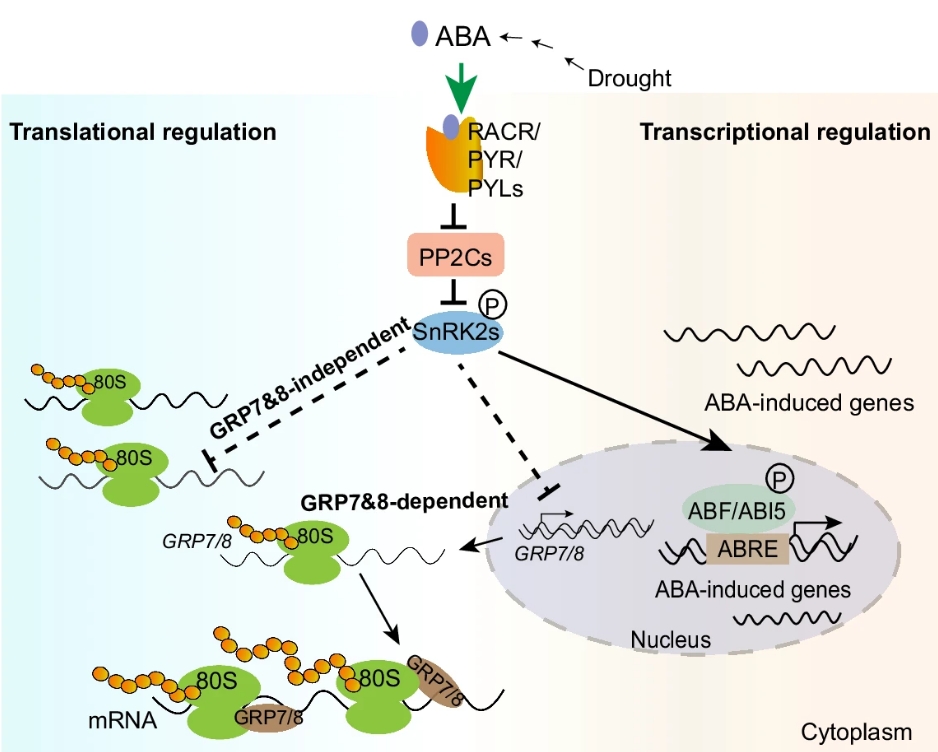
In a new study published in Nature Communications on April 26, researchers led by XIAO Jun from the Institute of Genetics and Developmental Biology of the Chinese Academy of Sciences, in collaboration with YU Xiang's group at Shanghai Jiao Tong University, have uncovered a novel mechanism by which the plant hormone abscisic acid (ABA) regulates mRNA translation through the RNA-binding protein GRP7.
ABA is a crucial hormone that regulates plant growth, development, and stress responses. The initiation of ABA signaling relies on the binding of ABA to its receptors, RACR/PYR/PYLs, which inhibits the phosphatase activity of PP2Cs, thereby activating SNF1-related protein kinases 2s (SnRK2s). These kinases further activate ABRE-binding factors (AREB/ABF), enhancing the transcriptional expression of ABA-responsive genes. While much is known about ABA's role in transcriptional regulation, its involvement in translation regulation has been less explored. This study marks the first comprehensive investigation into how ABA modulates global mRNA translation efficiency.
Using an integrative approach that combined transcriptomics, translatomics, molecular biology, biochemistry, and genetics, the researchers demonstrated that ABA signaling components—including RCAR/PYR/PYLs receptors, PP2Cs, and SnRK2 kinases—also influence translation efficiency. Immunoprecipitation-mass spectrometry (IP-MS) analysis identified Glycine-rich RNA-binding protein 7 (GRP7) as a ribosome-associated protein responsive to ABA. GRP7 and its homolog GRP8, which share high sequence similarity and functional redundancy, were further studied using a CRISPR/Cas9-engineered double mutant (grp7grp8).
Polysome profiling and SUnSET experiments revealed that the global mRNA translation efficiency inhibition by ABA was significantly weakened in the grp7grp8 mutant, indicating that GRP7 and GRP8 play important roles in ABA-mediated translation regulation. However, ABA still reduced mRNA translation efficiency in grp7grp8, suggesting that ABA regulates translation through both GRP7&8-dependent and -independent pathways. These pathways may act sequentially: initially, the GRP7&8-independent mechanism triggers the first wave of translation and transcription regulation, including the expression of GRP7/8 genes themselves. Subsequently, the reduced levels of GRP7&8 trigger a second wave of translation regulation.
The researchers also found that ABA activates AREB/ABFs through SnRK2s for transcriptional regulation while inhibiting GRP7&8-mediated translation regulation. By creating a quintuple mutant combining grp7grp8 with snrk2.2/2.3/2.6 through hybridization, genetic phenotyping revealed that under low ABA concentrations, the transcriptional regulation mediated by AREB/ABFs dominates, whereas under high ABA concentrations, the translation regulation mediated by GRP7&8 becomes more significant.
Joint analysis of Ribo-seq and CLIP-seq data showed that GRP7 directly binds to its target mRNAs, playing a key role in ABA-mediated translation regulation. Additionally, the regulation of mRNA translation efficiency under drought stress partially depends on the ABA-GRP7&8 pathway.
This study has unveiled the molecular mechanisms of GRP7&8 in ABA signal-mediated translation regulation, offering new insights into ABA-mediated environmental adaptability. The GRPs proteins are highly conserved in Arabidopsis and cereal crops, making these findings potentially valuable for improving crop stress resistance and providing new directions for studying the molecular mechanisms of crop stress responses.
It is worth noting that the detailed experimental methods, analysis methods, and quality control of data resources for the Ribo-seq and CLIP-seq experiments of Col-0 and grp7grp8 under ABA treatment were published in Scientific Data on December 28, 2024.
The study was supported by the Beijing Natural Science Foundation's Outstanding Youth Project, the National Key R & D Program of China, and the National Natural Science Foundation of China, among others.
Working model for the regulatory role of GRP7 in ABA signal-mediated mRNA translation efficiency regulation (Image by IGDB)